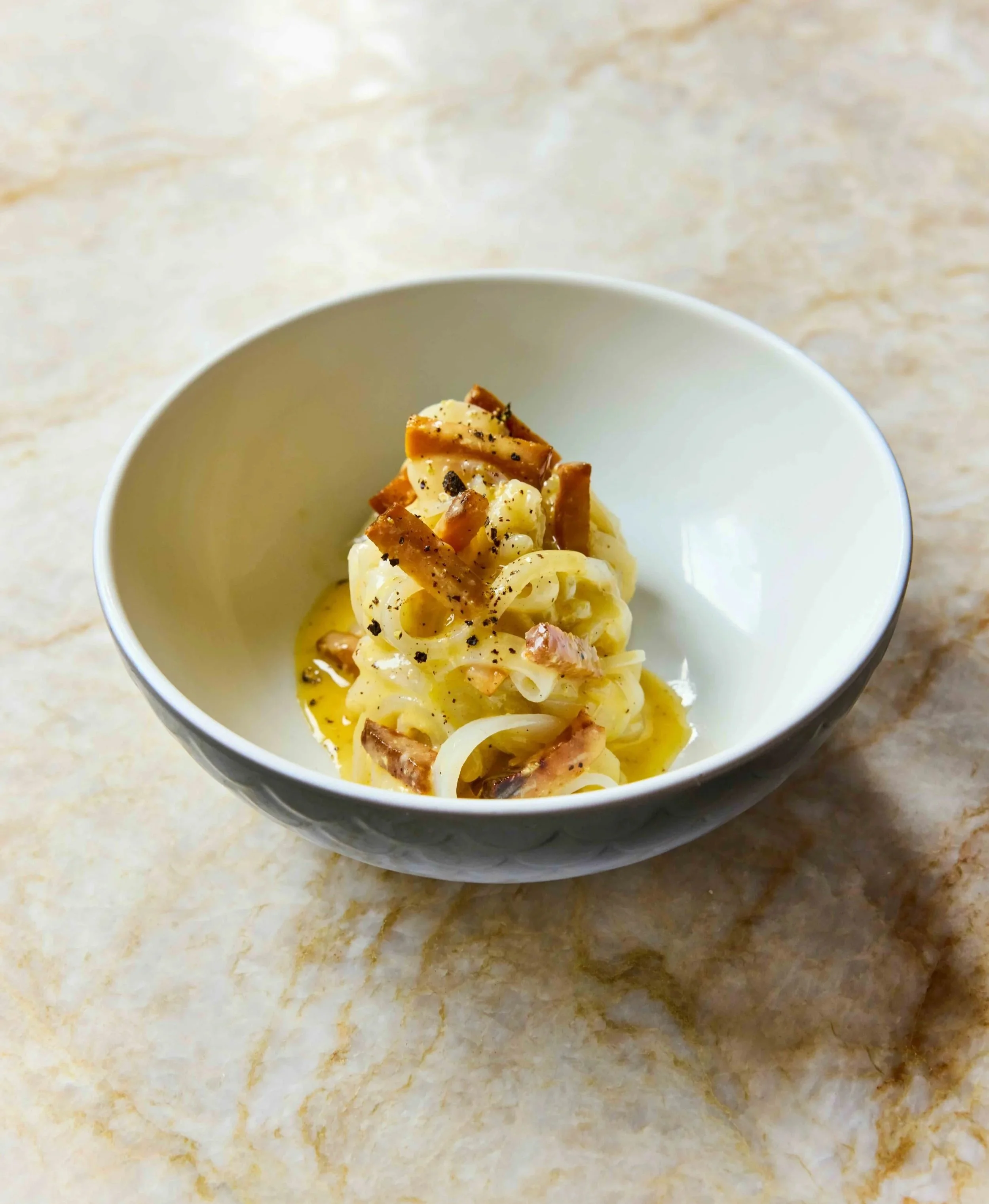
Calamari carbonara - Saint Peter
“Like our calamari and 'nduja (page 312), this is another pasta-style dish that we first did before we had ever thought about making yellowfin tuna 'nduja. Having swordfish bacon as part of the repertoire meant that we could explore a long list of traditionally pork-based dishes that could be replaced with swordfish.
The calamari preparation gives us a rice noodle-like texture, so we had the pasta. Then it was finding a way to make a sauce light enough not to compromise the taste of the calamari but coating it in a way that made you feel like you were eating the perfect carbonara.
Still to this day, this is a dish that always manages to shock and awe guests.” — Josh Niland
Serves 4
300g whole calamari
20g ghee, melted
80g Swordfish belly bacon lardons (see below)
60ml verjuice
150g cold butter, diced
5g black pepper (or to taste)
2 tblsp finely grated pecorino romano
2 egg yolks
freshly cracked black pepper
Swordfish belly bacon - Makes 1 bacon belly
swordfish belly, skin on
Dry bacon cure
500g caster sugar
1kg table salt
30g ground star anise
150g ground cumin
50g cure #1
150g ground black pepper
150g ground coriander
150g ground fennel
To prepare the calamari, start by removing the wings and outside skin along with the gut, quill and tentacles. All of this should be kept for future uses. (The Fish-eye chips (page 119) use calamari eyes, the ink can go in Black garlic hollandaise (page 160) and the tentacles and wings in the Salt and pepperberry calamari recipe (page 379).) Cut the hood open using the firm line on the back of the calamari as a guide. Once open like a book, use a knife or pastry card to wipe away any sediment within, then thoroughly clean both sides with a paper towel. Take a sharp knife and make a horizontal incision about 1cm from the base of the outside of the hood but not all the way through to the other side. Use this cut to pull away the thin membrane up towards the top. Repeat this step on the inside of the hood. Once both are removed, set aside in the fridge.
Prepare a charcoal grill, making sure the charcoal has cooked down to hot embers. To create the gentle heat required for this particular method, take care not to overload your grill with too much charcoal and make sure the coals are spread evenly across the floor of the grill.
Place a wire rack onto the grill and place the calamari onto the rack. Cook for about 20 seconds and tum, then repeat this process until the calamari has cooked for about 60 to 90 seconds in total. It will really depend on how thick the calamari is as to how long it is cooked for but the aim is to not apply any colour at all, and the end product should be similar to a rice noodle in texture and appearance. It is important for this particular dish that the calamari be undercooked on the grill so that the warm sauce that gets added later doesn't overcook it.
Once cooked, remove the calamari from the grill and use a long, sharp chef's knife to finely slice lengthways into long, thin ribbons. Place in a warm mixing bowl and set aside.
In a medium saucepan, heat the ghee to a light haze. Add the swordfish bacon lardons and fry until evenly golden brown, about 2 minutes. Deglaze the pan with the verjuice and allow it to reduce to a syrup around the bacon, about 2 minutes. Once reduced, gradually add pieces of butter to the syrup and swirl the pan to ensure the sauce thickens and the butter doesn't split. If the sauce gets too thick, add a splash of water to assist in making a stable emulsion. Once all the butter has been added, the consistency should coat the back of a spoon evenly and have a nice balance of seasoning and smoke from the bacon along with sweetness and sourness from the verjuice. The sauce shouldn't be any thicker than cream at this point. Keep on a low heat until required.
In a small mixing bowl, combine the cheese with the egg yolks and a very generous amount of freshly cracked black pepper. Whisk this together with a couple of tablespoons of hot water to create a thick paste. With the bacon butter sitting warm on a low flame, gradually whisk in the egg paste to create a fine texture. Once thoroughly combined, adjust the seasoning with a little salt and more pepper if you wish.
Gradually pour the warm bacon butter over the bowl of calamari, stirring after each addition. You want just enough sauce to coat the ribbons of calamari. It is a real balance at this point as the dish begins to cool so that the texture of the entire dish remains silky and light, not thick and heavy. Balance this with warm water if required.
Check for seasoning one last time and then use your hand to pick up a small handful of the calamari and lower the dangling noodles over a serving bowl. As the calamari touches the bowl, tum the bowl anticlockwise with your other hand and allow gravity and the moving bowl to create a small nest. Spoon over any last little pieces of the swordfish bacon and give the dish one final crack of pepper.
Swordfish belly bacon -Combine the cure ingredients in a bowl. Weigh the fish and use the ratio of 130g of dry bacon cure per 1kg of fish. Sprinkle the cure evenly over the belly and place on a stainless-steel tray. Refrigerate and allow the fish to cure for 7 days, turning each day, then rub off the excess cure.
In a smoker set as per the directions, cold smoke the belly for 2 hours. Hang the smoked belly on a butcher's hook in a fan-forced refrigerator for between 7 and 14 days, depending on its humidity. Once the fillet has reduced by 30 per cent of its original raw weight, the bacon can be sliced and used.

This is an edited extract from Saint Peter by Josh Niland, published by Hardie Grant Books.
📷 Photography by David Loftus.